
Use sourdough starter to make sourdough bread or add some to cake recipes to assist rising. It also provides a lovely sour flavor and boost to other yeast-based recipes. It ferments naturally and rapidly, without commercial yeast.
I use the below recipe in my Gluten Free Sourdough Bread Recipe.
I’ve learned that the use of brown rice flour achieves the best results in creating the ideal gluten free sourdough bread starter. And though I have created a sourdough starter from white rice flour, I’ve discovered that without the use of yeast, brown rice creates a better one. Below, I’ve provided you with some interesting tips you may have not read before that will help you achieve a successful gluten free sourdough starter, as well as address the issue of arsenic in brown rice/rice products.
Introduction to Starters
First, let me start by simply defining a “starter”. Then I’ll go into the technical details afterward. A sourdough starter is not a sourdough bread recipe, it is just used in a sourdough bread recipe. (Though I am working on perfecting a great sourdough French bread recipe.) The starter provides the sour taste. Many of us in the gluten free community have trouble with making starters. They often spoil, become moldy, never develop enough yeast, or never become bubbly. Therefore, many gluten free starter recipes call for commercial/dry yeast. However, if you’ve made regular gluten starters in the past and are dead-set on not using yeast, this recipe will be a welcomed delight to your gluten free recipe collection.
Add Yeast or No Yeast?
A sourdough starter is made by fermenting dough that naturally develops yeasts and lactobacilli. Naturally developed yeast has a milder sour flavor than when adding dry yeast. The sour flavor comes from the acetic acid it produces. The lactic acid produces a smooth, milder flavor. Lactic acid is produced by the lactobacilli that forms in the starter. Therefore, because of its mild sourdough flavor, I will use yeast in the actual sourdough bread recipe, though this starter recipe does not contain any. I wanted to create it for those who do not use dry yeast in their diets. In addition, in my actual bread recipe I will use other sour ingredients to create a good sourdough flavor. I also enjoy knowing that sourdough bread is healthier for us, as the natural yeast that develops helps create intestinal flora which is essential to our digestive process.
Essential Tips
What Makes This Gluten Free Sourdough Starter Unique?
Utensils: What really made this starter successful was the type of bowl that I used. If you’re familiar with gluten sourdough starters, you may have read never to use metal bowls or utensils. This is a misunderstood myth as far as the preparation of the starter goes. The use of metal utensils in stirring or using a metal bowl to mix your starter will not kill the yeast. If you’re still set against the use of metal you can always use a silicone coated whisk.
However, after my experiment was successful, I searched the Internet and found a number of articles that backed up my conclusion. You may read one of them at “Can I use metal with sourdough“? It explains that if you were to store your starter in a metal bowl the metal would change colors and the metal may leak into your starter. The acid eats away at the metal, but it doesn’t kill the yeast. In the case of a gluten free sourdough starter, using plastic is essential. Perhaps you’ve heard that all of our plastic water bottles grow bacteria easily. Well, that sure comes in handy when developing yeast in a gluten free sourdough starter. Using metal did not seem to affect it, as the starter was complete in just 3 days. Another thing I discovered was that the use of warm water helps the process proceed much faster, heating the water to 110°F in the initial step, as well as in the feeding process. It creates a warm environment for those friendly creatures to grow. Lactobacilli, which grows in a non-commercial yeast starter, thrives in a warm environment. Commercial yeast thrives more in a wet environment.
What Temperature Should the Environment Be?
The temperature of the environment you place it in is also crucial. The ideal temperature to keep your starter is supposed to be 80°F. However, I have achieved a perfect gluten free sourdough starter in colder environments such as 67 degrees. Brown rice starters that are in colder environments may need to be fed less often, while warmer environments may need to be fed more often. Up to 8 times a day wouldn’t be too much in a warm environment. At 70 – 80°F, every 4 hours is sufficient.
Similarly, it may take less time to achieve the final results in warm weather and more time in cold weather.
Hooch
You’ll notice that your starter will form a greyish liquid (hooch) when it has gone hungry. It starts to feed on itself and its own waste. This is not healthy for the starter. However, with gluten free starters, you will not achieve much of a sour taste unless you include some of the hooch. Some people include some hooch even in starters made from gluten flour.
Arsenic in Rice Products
As a side note, most of you are probably already aware of arsenic levels found in brown rice, higher than in white rice. I started this experiment prior to it being announced in the news. After much research, I have discovered there are two sources of arsenic in rice, naturally occurring in soil (organic); and from pesticides, etc. (inorganic). Organic arsenic is 500 times more tolerable than non-organic, which comes from pesticides. You can also check with a manufacturer to see what they are doing to test or prevent arsenic levels. The World Health Organization, the UK, and Australia allow 1 ppm (parts per million) in their food products. While the FDA is still trying to figure it out, they are suggesting .023ppm for juice. Currently the United States Environmental Protection Agency (EPA) has determined that 0.01 ppm (or 10 ppb) is the tolerable allowable in our drinking water. The United States has never had an allowance in food, though it is found in our produce and other food1. I feel confident in using Bob’s Red Mill Organic Brown Rice Flour.
In addition, California has the healthiest brown rice.
Summary
As reminders, the essential things to do to make a successful gluten free sourdough starter without yeast are to use a plastic container, use warm water never hotter than 110°F, keep your starter warm, and do not store it in a metal container.

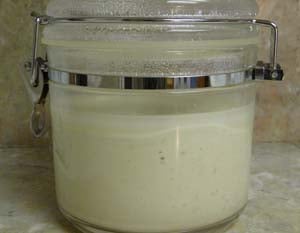
A gluten free sourdough starter made from organic brown rice flour. (2 Days in the refrigerator pictured above.)
Ingredients:
- 1 cup water, warmed to 80 - 110°F (228g)
- 1 cup brown rice flour (not superfine) (140g)
- 1/4 cup water, warmed to 80 - 110°F (57g)
- 1/4 cup brown rice flour (not superfine) (35g)
Instructions:
- Pour the warm water into a large plastic bowl. Sprinkle the rice flour evenly over the surface. Whisk until the mixture becomes a bit bubbly. Allow it to sit at room temperature for 4 hours, uncovered.
- Every 4 hours (waking hours), for 1 to 2-1/2 days, feed your starter by first emptying out about half of the watery liquid (hooch - which may be grayish in color). If there is hardly any hooch present, allow it all to remain. However, if there is about 1/4-inch or more floating on top go ahead and drain off half. Then pour in 1/4 cup warm water. Sprinkle the top of the water with 1/4 cup brown rice flour. Whisk together. If you live in a humid environment, wipe down the sides of the bowl. This prevents mold from growing. I use a damp paper towel. Cover the bowl loosely with plastic wrap or a lid; set aside for another 4 hours. If any mold grows on the starter or in the bowl, discard and start over. Repeat every 4 hours or until it is extremely bubbly and smells sour, not bad.
- After the last feeding, allow it to rest at room temperature for the usual 4 hours. Then refrigerate your starter for future use; or use it immediately in your favorite recipe.
- When using this starter after it has been refrigerated, drain off any liquid and feed it again (1/4 cup brown rice flour and 1/4 cup warm water). Then allow it to rest at room temperature for at least 2 hours, no longer than 4. Just be sure it is bubbly before using and is at room temperature.
- If used often enough, you will never have to make the starter again. Just keep replacing the starter you use by adding equal amounts of warm water and brown rice, totaling the same amount you used in your last recipe. Thin or thicken, as desired. Then to use the starter again, follow the above instructions for a refrigerated starter. Refrigerate when not in a 4-hour feeding cycle.
Tips
Though this gluten free starter recipe contains no yeast in its ingredients, it does contain yeast in the end result.Therefore, I place this in my Yeast-Free category loosely, not literally.
Hooch: When hooch forms, it is a sign that your starter is hungry. When you see this often, be sure to feed your starter more, or more frequently. However, I usually just throw mine out and start over, especially if it has happened more than once.
Reference 1: Opinion Letter by Wil Summer, Former Supervisor for the FDA and California State Attorney General’s Office and Prop 65 California State Attorney General’s Office and Prop 65, http://www.growingnaturals.com/images/faq/ArsenicInFoodOpinionLetter.pdf(Accessed on 9/25/2012) Updated to https://growingnaturals.com/blogs/blog/arsenic-levels-in-brown-rice-ingredients?_pos=1&_sid=eb35469bd&_ss=r (Accessed March 9, 2022)
A few questions as I have not been very successful with the starter. I’m going to try again with this recipe.
1. I found a starter I made about a year ago in my fridge. Should I toss it out?
2. When I use the starter in a recipe what should the consistency be?
Like Pancake batter?
3. Can I use a gluten free starter in regular wheat sourdough bread recipes?
Thank you Carla!!
Hi Theresa,
1. To find out if your starter is still good, bring it to room temperature and if it bubbles up, it’s good. However, I’m sure that there is no mold, mildew odor.
2. I’ve received the same question about consistency and will create a video showing what I do. Currently, I’m retired and remodeling our home. So, it may be awhile. Until then, because environments differ and effect starts on differ ways, I suggest experimenting on your own. Ask me questions as you go along. If you’re familiar with the consistency of gluten free bread dough, when making the final sourdough bread recipe, shoot for the same consistency: a sticky dough that is spreadable. Liquid helps it rise. So, don’t make it too stiff. If you’re not familiar with gluten free dough consistency check out my out bread in a machine video.
3. Wheat creates a stronger sourdough flavor. So, I would suggest using wheat flour for a wheat-based recipe. However, gluten baking is not my specialty.
Good luck!
Carla
How big of a container should I use?
Thanks!
Maria,
My container was about 6 inches wide and 7 inches high. I’m referring to the container in the photo.
Carla
what can i use for the sourdough starter if i am allergic to rice
For how long can I store the starter in a fridge?
Martha,
Storing the starter varies greatly. It depends on the temperature of your fridge, how often you open it, and how often you use and feed the starter. I’m sorry I can’t be more specific. I’ve stored it at least one month, but then I through it out because I needed the fridge space.
Carla
I just made the sourdough starter, 2c rice flour, 2c warm water. It is a dough, not liquids at all. Is this right?
Joanna,
You want this sourdough starter to be thick. It will thin out as it goes along. I’m not talking like a bread dough, but like a pancake batter.
Before you measure your flour, loosen it up. Then, using a spoon, spoon it into dry measuring cups. If you use a liquid measuring cup and scoop the cup into a container of flour, it will become compacted, providing you with much more flour.
I hope this helps.
Carla
I’m making your sourdough starter, as we “speak”. I started it last night about 7:30PM, using organic brown rice freshly milled in my mill, I also used distilled water – just whisked it for about 2 minutes (did not use a beater). I placed them in a ceramic crock and placed it on a heating pad set on low. My digital thermometer read about 80 degrees. I whisked it again for about 2 minutes at 9:30PM – it was bubbling already, and went to bed.
This morning, at 7:00AM, it looked good. There was a nice little dome on top and only a small amount of “hooch”, which I poured off for the most part. I added 1/4 cup of water distilled water by the way, each time) and 1/4 cup of organic brown rice flour (ground fresh in my own mill), stirred it in for about 2 minutes. By 11 AM things looked real good. It had “risen nicely with good bubbles. Nice little dome on top, virtually no “water/hooch”.
I just checked it again, 3:00PM, and there is a nice little dome on it with no “hooch” showing.
I’m not sure just how soon this will be considered ready for use. With this much bubbling and growth it seems to be doing very well indeed, based on previous experience with whole wheat sourdough starter I’ve used. I’m wondering if this is not almost ready to use, but it’s only been 20 hours. This seems to be like a pre-ferment, which would be fine with me since I really don’t need a “sour” flavor for my tastes.
What are your thoughts?
Also, I’m wondering if one could use a separate starter for each flour included in a bread instead of just the brown rice one. (i.e. sorghum starter and brown rice starter for a blended product.) and how that might affect the outcome.
Would it perhaps make the vitamins, minerals and enzymes in EACH flour more bioavailable than just using the rice starter?
And if one were to “pre-ferment”, or make a sourdough starter out of the entire flour portion of a bread what do you think would happen when it came time to bake it? Would it still rise properly? Do you anticipate other issues may develop?
I’m particularly interested in eliminating the grittiness from the rice flour, thinking a pre-ferment of the entire portion of the rice may provide more complete hydration, and thus a softened rice flour (like cooked rice). I’d welcome your thoughts on this.
Thanks for your kind reply and your good information on your site.
Hi Bob,
The temperature of the environment always plays a roll in a sourdough starter. If you have plenty of bubbling going on it sounds like it could be ready, but I have never had this sourdough starter ready in such a short time. Therefore, I am a bit loss for advice. If you are using it help lighten a cake recipe or other baked good, it surely could not hurt it by using it now.
In addition, you want to drain off all hooch whenever possible.
Carla
There is a bakery in Portland, Oregon that is making gluten-free bread with a non-sourdough starter. The result is a crusty, European-style “rustic baguette.” It’s amazing but we don’t live anywhere near Portland anymore and want to make our own. I found your sourdough starter recipe but my family’s not crazy about sourdough. Any ideas about creating a non-sour starter (sometimes called biga)? I tried to get them to sell me some last time I was there. No luck. Thanks!!
Hi MamaSita,
I do not have a non-sourdough starter recipe; however, if you use buttermilk in your bread recipe it will neutralize some of the acids to prevent that sourdough taste. I recently used too much in one of my experimental recipes and it had no sourdough flavor at all. I used 1 3/4 cups of this starter and and 3/4 cup buttermilk, plus some water.
In addition, most recipes for gluten-free sourdough starters are a biga. A biga is a starter that uses commercial yeast. My recipe is unique as it is made the old fashioned way, without commercial yeast. You will find a recipe in Carol Fenster’s “1000 Gluten-Free Recipes” for one made with commercial yeast. Check out her cookbook in my Gluten Free Online Store –
I hope this helps.
Carla
Where is the recipe for the bread WITHOUT the yeast?
Sherrie,
As stated on this page, the recipe I would be creating would contain yeast. Though this sourdough starter does not contain yeast, yeast develops in any food that ferments. It is not meant for those with yeast allergies. I have not created a recipe for sourdough bread without yeast yet. Sorry, but I still need to improve upon the one I developed that contains yeast.
The purpose of my experiment with this recipe was to create a starter the traditional way, without the use of commercial yeast.
You probably can use this starter in any bread recipe you already enjoy. If you use 2 parts flour and 1 part water in your starter, try using 1 cup starter to replace 2/3 cup flour blend and 1/3 cup liquid. If you use half water and half flour in the starter, then use a cup of starter to replace 1/2 flour and 1/2 cup liquid. You must take into account any liquid you pour off. I have stopped pouring off the liquid in my starter.
I hope this helps.
Meanwhile, i have added the word “commercial” prior to the word “yeast” to clarify for those in the future.
Carla
Im confused. Do I pour off or not pour off?
Also Im at 8200 ft elevation. What adjustments should I make!?
thanks so much, we are going gluten free for my sons sake and really love sourdough!
Hi Lulie,
Sorry about that. I had left 2 separate updates in the recipe. It’s now updated to read, “I now only empty out half of the sour, greyish colored liquid that forms in the starter and add about 1/2 cup of flour and 1/4 warm water to feed it. In addition, I do not empty any of the starter when feeding it.”
Carla
I really like the idea of lactobacilli forming during the fermentation process. Won’t it be destroyed in the baking process due to the heat?
Hi Casper,
I do not believe that the lactobacilli is destroyed when baked. Research has been performed showing that lactobacilli in sourdough bread may reduce cross-contamination of gluten. I haven’t read this full article, but have requested a full version. See the abstract at http://www.ncbi.nlm.nih.gov/pubmed/17008163. Here is an article dated 2004 from celiac.com: http://www.celiac.com/articles/752/1/Study-Finds-Wheat-based-Sourdough-Bread-Started-with-Selected-Lactobacilli-is-Tolerated-by-Celiac-Disease-Patients/Page1.html.
Thanks for your question,
Carla
Such a helpful blog!
I am new to baking so I’m clueless!!! My friends have all recommended Sourdough’s International’s sourdough starter to me, so I’m going to give it a go!!!
I’ve always wanted to make my own sourdough starter,…now’s the time!!