
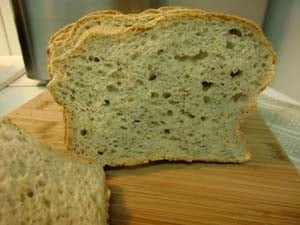
I have been experimenting with this gluten free sandwich bread recipe that can be used for sandwiches and I have found that adding additional egg white turns out a much softer bread dough. It was heaven! – much like a homemade white bread texture, but not as starchy because I used mainly oat flour. I tried adding one additional large egg to my original gluten-free oat bread recipe and it turned out much better! Instead of adding 4 large egg whites, as mentioned in the recipe below, I added 2 large and 2 extra large. I have found that the more egg white you add, the larger and softer the bread. You do, however, have to be careful of adding too many, as you do not want the texture of cake. Watch the video of me making this Gluten Free Oat Bread.
I need to make the dough larger for a 9×5″ loaf pan. So, I added some flaxseed meal for extra fiber and because it is rich in omega 3 fatty acid (ALA only) (there are 3 types of omega 3’s: ALA, DHA and EPA) and contains antioxidants.
You should be aware, though, that flaxseed is not intended to be a source of omega 3 for children. Small children do not yet convert flaxseed oil into DHA yet. Even adult bodies can only turn so much flaxseed oil into DHA.
Interestingly, I discovered that flaxseed oil contains phytoestrogens, also known as “dietary estrogens”. Flaxseed will affect the way estrogen is handled in postmenopausal women, and flaxseed contains 3 more times than soy, per one study. Therefore, it is not suggested for pregnant or nursing women, or children to consume flaxseed.
It is always best to vary your diet so you not only absorb various nutrients, and so that you do not absorb too much of anything.
See the video on how to make this gluten free sandwich bread recipe.
Ingredients:
- 1 cup water, heated to 110°F
- 2 Tablespoons agave syrup/nectar, sugar, evaporated cane juice or honey
- 1 packet or 2 1/4 teaspoons instant dry yeast
- 1 1/4 cups gluten-free oat flour (or sorghum flour, if oat intolerant)
- 1 cup potato starch
- 1/2 cup tapioca flour/starch
- 1/4 cup flax seed meal
- 1 1/2 teaspoons xanthan gum (use corn-free, brand if needed or more guar gum)
- 1 1/2 teaspoon guar gum
- 3/4 teaspoon sea salt
- 2 teaspoons gluten-free apple cider vinegar (I used Heinz)
- 4 large egg whites, at room temperature
- 1/4 cup extra virgin olive oil
- Oil or gluten free spray oil for pan
- 2 teaspoons gluten-free oats for top (optional) + egg wash = (egg white + water)
Instructions:
- Grease or spray oil a 9×5" silver metal loaf pan (not black inside, because silver cooks more evenly).
- Preheat oven to 170 – 200°F (lowest possible)
- Mix warm water with agave and yeast in a cup and set aside until foamy on the top, about 5 minutes or more, while you prepare the flour mixture.
- Beat the eggs at high speed in a large mixing bowl until bubbly, about 30 seconds.
- Whisk together the dry ingredients; set aside.
- Add the oil, vinegar and yeast mixture to the egg whites and blend on low for a short time. (#2 on a KitchenAid mixer). Stop mixer.
- Add dry ingredients all at once and blend for a short time until all dry ingredients are moistened. Then change speed to high (# 10 on KitchenAid) and beat for 1 minute.
- Add dough batter to prepared pan and pat with a little cold water using a rubber spatula or your fingers. Distribute dough evenly to meet all sides of the pan and smooth out top. Do not be cautious on using too much water, as it this will help the bread brown.
- Set pan in a warm environment. Turn oven off. Place the bread pan in the oven. Close the oven door and allow the dough to rise until it is about 1" over the top of the pan, about 40 minutes.
- Remove pan from oven and preheat oven to 375°F.
- Place the pan on the center of the rack in the center of the oven and bake for about 37 – 45 minutes or until dough reaches 205°F. My oven takes 37 minutes.
- Remove the loaf from the oven and immediately remove it from the pan (careful it will be hot) and set the loaf on a cooling rack to cool.
- Slice with an electric slicer, electric knife or serrated knife.
Nutritional Facts (based upon Bob’s Red Mill flours, starches and gums)
Amount Per Serving: 1 slice
Gluten Free Oat Bread
Calories 174.4
Total Fat 5.9 g
Saturated Fat 0.8 g
Polyunsaturated Fat 1.2 g
Monounsaturated Fat 3.2 g
Cholesterol 0.0 mg
Sodium 148.7 mg
Potassium 28.7 mg
Total Carbohydrate 27.6 g
Dietary Fiber 2.3 g
Sugars 2.5 g
Protein 4.1
Gluten Free Sorghum Bread
Calories 174.0
Total Fat 5.4 g
Saturated Fat 0.7 g
Polyunsaturated Fat 1.2 g
Monounsaturated Fat 3.2 g
Cholesterol 0.0 mg
Sodium 148.8 mg
Potassium 28.7 mg
Total Carbohydrate 29.7 g
Dietary Fiber 2.3 g
Sugars 2.5 g
Protein 3.6
Weight Watcher’s Points: 5
beyond excited to try this recipe I have been diagnosed with corn, sugar, dairy, gluten intolerance and need some bread real bread. I finally found a corn free yeast and im so excited waiting right now for my bread to cool!!! Ah! its gonna be epic!!
Hi Anna,
I hope it turns out well for you! Thanks for leaving a comment.
Are you using the packets of active dry yeast instead of SAF instant yeast?
Carla
I just made this bread and it’s amazing ! I’m going to pass this recipe along to all my gluten free friends. Thank you so much for sharing. ♥
This was my first time making GF Bread and this recipe turned out awesome. Thank you for sharing!
Thank you so much for sharing the sandwich bread. Excellent! Soft on the inside and crunchy on the outside.I can’t really taste the difference from the gluten bread! Thanks again.
Chiara,
You’re very welcome! If you’re dairy tolerant, you’ll love this recipe even more: http://glutenfreerecipebox.com/gluten-free-oat-bread-2/
Enjoy!
Carla
Hello!!!! I am new to gluten free baking, and I have tried at least 10 recipes, but my bread only rises a wee bit. I LOVE this recipe, the taste is fantastic (made with sorghum), but it only rose about 25%. What can I do? I proofed the yeast and it was fine. I would really appreciate any tips!! My son is 5 years old and has been diagnosed with celiac disease (and he has a dairy and soy allergy), so it is lovely to find a recipe without those ingredients!
Thank you so much!!!:)
Hi Jodie,
From your earlier comments, if I remember correctly, you’ve been having some issues with some recipes. Am I correct to assume you are new at gluten-free baking?
This recipe was created by Carol Fenster and made by thousands of people successfully, so I will help in any way I can.
My free ebook, “Gluten-Free Bread Baking Defined” should answer your question on bread baking: http://glutenfreerecipebox.com/gluten-free-bread-baking on updating it soon, as it is short. Besides the tips in my ebook, the only thing I can add at this time is to ensure you oil your pan liberally. If you don’t the dough may stick to the sides. Another tip is to allow your bread to rise without oven heat, 80 degrees fahrenheit is best.
I also find that when you are new to a recipe you may be slow in the handling of the dough, allowing it to rise well before placing it in the pan, smashing down all of those air bubbles. Watching my video on making one of my bread recipes may help you: http://glutenfreerecipebox.com/gluten-free-recipes-videos
Hope this helps!
Carla
Thank you so much Carla! This is actually the first time I have ever seen one of your recipes or replied to a link:) There must be another Jodie out there!
I will definitely check out your ebook and I will put your suggestions to use and see what happens:)
Jodie
Hi Carla! I have looked at your ebook and it is fantastic! I have implemented your suggestions and I now make this bread 2-3 times a week and it works out perfectly every time! Thanks again:)
Hi Jodie,
Thanks for letting me know you are enjoying my ebook, as well as this gluten free bread recipe. If you tolerate dairy, you’ll love this one: http://glutenfreerecipebox.com/gluten-free-oat-bread-2
Happy gluten-free cooking to you!
Carla
I’ve just made this lovely bread I was just wondering if it needs to be stored in the freezer as so many other of these breads do.
CC,
I’m so glad you enjoyed this recipe.
Yes. All gluten-free bread without preservatives should be frozen. Microwaving on a low temperature makes it like fresh bread, but a little softer. If you’re not into killing all of the nutrients by microwave use, you may microwave a damp paper towel, lay it atop the slices at room temperature until they are defrosted.
I hope this helps.
Carla
Would this work in a bread machine?
Cindy,
Sorry, but this recipe would not work in a bread machine. The dough is too soft. I’ve found that bread baked in machine is much is not as good as that of those baked in the oven. You cannot control when it begins to bake. The perfect gluten-free bread, especially for sandwiches is baked in an oven. At least that’s my experience.
Carla
This sounds really good and easy and I am looking forward to trying it, the only concern I have is I am yeast intolerant so I am wondering if I would use the same measurements for using baking soda? I’ve used baking soda in the past before for other baked goods that needed it and it has worked out fine but I have never had to use it in a bread recipe, would you have any suggestions as to what I could do?
Hi Kelly,
I have tried about 6 times now to develop a good yeast-free bread recipe. Unfortunately, I have not had any success yet. I rally feel for you. Sign up for my newsletter, and hopefully sometime in the future I’ll have a recipe you that you can used for sliced bread. For now, you may wish to check out my yeast-free gluten-free flatbread recipe: http://glutenfreerecipebox.com/gluten-free-flatbread Enjoy!
Carla
This looks really good! I was wondering before I made this if I can use xanthan gum in place of the guar gum since i can’t find it anywhere locally? Thanks for any help and thank you for your time!!
Stephanie, Most definitely! Enjoy! And check out my videos on how to make it: http://glutenfreerecipebox.com/gluten-free-bread-recipe-oat-sorghum and how to make it better: http://glutenfreerecipebox.com/video-hd-soft-gluten-free-oat-bread.
Comment from “Guar Gum vs Xanthan” post:
“I made your oat/flaxseed bread again, but this time it didn’t rise. Can’t figure out what happen. Thought I did everything the same as the first time when it came out really good. I don’t think I overworked the dough.” – Kathy
Hi Kathy,
There a number of factors which can cause a bread not to rise:
• Expired yeast
• Ingredients were not at room temperature
• Water was too cold, did not activate the yeast
• Water too hot, killed the yeast
• Improper measurement of ingredients, especially flours and starches, possibly packed too tightly
• Dough not beaten not enough to form gluten
• Dough beaten too much to make dough runny
• Rising place too cool
• The use of white vinegar instead of apple cider; apple cider is higher in acidic value which yeast thrives on
Hope this helps!
Thank you so much for your great recipes, makes living easier with food allergies. Is there another flour I can replace with potato, as I am also allergic that as well.
Hi Beverly,
You are very welcome!
I haven’t experimented much with arrowroot, but you could give that a try. You may wish to use less, though. Cornstarch is used as a substitute for tapioca starch. It’s light. If you’re not corn intolerant that would be a good one to use if you’re making the oat bread, which tends to be heavier.
Good luck with your gluten free baking!
Carla
I do not see a print button. Am I missing it?
I do not have a cuisinart, but I have a food processor. Would that work? If not, do I have to use a cuisinart?
Thank you
Hi Kathy,
Thanks for your questions.
You need to use a mixer for this recipe. Any electric mixer will do. I meant to write KitchenAid mixer, not Cuisinart mixer, though I wouldn’t doubt if Cuisinart brand made a mixer, as well.
To print any article or recipe on this site, just click on “Share” beneath the recipe or article and then click on Print.
I hope this helps!
Carla
HI! Wondering what i could substitute oat flour with? also, could i do egg replacer instead of the egg whites? I am searching for a soft bread…. nothing like soda bread.
We. are. desperate.
Hi Kristen,
I have never used egg replacer. I get this question quite often, therefore, I think it’s about time I give it a try. If you do not eat oats because you react to them, just note that there are brands of oats that are gluten-free (mostly free of cross-contamination). As far as substitutions for the oat flour, you may benefit from reading this article which provides a few flour choices: http://glutenfreerecipebox.com/best-gluten-free-bread Good luck!