
I had posted a link to the Gluten Free Prairie Oat Bread I had developed for Gluten Free Prairie awhile back on my social media channels. However, that gluten free oat bread recipe was developed specifically for Gluten Free Prairie Oats, as their product produces a higher rise and a lighter bread. So, I thought you’d all appreciate a similar oat bread recipe which included dairy that can be used with any gluten free oats. And here it is! Using dairy guarantees a higher rise and less, if not any, shrinkage. If you’d like to watch a video of a similar recipe, see the older version of my Dairy-Free Gluten Free Oat Bread (or Sorghum) Recipe. I hope you enjoy this recipe. My husband loves it, and he eats gluten!
Update – Jan. 14, 2012: I recently used half mild/light molasses and half amber agave; added 1/4 cup oat flour; 3 tablespoons potato starch, and 2 tablespoons tapioca starch; and decreased the xanthan gum by 1/4 teaspoon – and it turned out very soft (mostly due to the decreased ratio of xanthan gum), and much higher (due to the added flour/starch). I had to bake it about 10 extra minutes. Baking additional time prevents the bread from caving in on the sides. Note that the less gum you use, the less structure. the dough will have. As an alternative to adding all of the additional ingredients, you can just make a huge batch of the dry mixture and use 3 1/3 cups in one bread recipe. (That’s what I do now.) Be sure to spoon the dry mixture into your dry measuring cups or it will pack it in too much. Try these changes in the original recipe and I am sure you will be pleased.

A gluten free oat or sorghum bread recipe made with instant non-fat milk, with a high rise, sandwich bread texture and low shrinkage.
Ingredients:
- 1 cup water, heated to 110°F
- 1/4 cup non-fat instant dry milk (optional)
- 2 Tablespoons agave syrup/nectar (or sugar, evaporated cane juice or honey)
- 2 1/4 teaspoons instant dry yeast
- 1 1/4 cups gluten-free oat flour (4 oz.); (or sorghum flour (5.5 oz.), if oat intolerant)
- 1 cup potato starch (5.2 oz.)
- 1/2 cup tapioca flour/starch (3.0 oz.)
- 1/4 cup flax seed meal (0.8 oz.)
- 1 Tablespoon xanthan gum (use corn-free brand or guar gum, if needed)
- 3/4 teaspoon fine sea salt
- 1 teaspoon apple cider vinegar (I used Heinz)
- 4 large egg whites, at room temperature
- 1/4 cup extra virgin olive oil
- Oil or gluten free spray oil for pan
- 2 teaspoons gluten-free oats for top (optional)
Instructions:
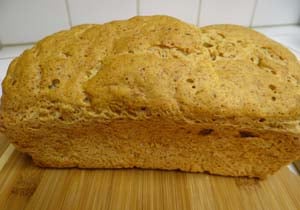
- Grease or spray oil a 9 x 4 x 4-inch or 9 × 5-inch metal loaf pan. (See photo above when baked in a 9 x 5-inch pan. It turns out rectangular.)
- Preheat oven to 170 – 200°F (lowest possible).
- Mix warm water, agave, instant milk, and yeast in a cup and set aside until foamy on the top, about 5 minutes or more, while you prepare the flour mixture.
- Beat the egg whites at high speed in a large mixing bowl until bubbly, about 30 seconds.
- Whisk together the remaining dry ingredients; and set aside.
- Add the oil, vinegar and yeast mixture into the egg whites and blend on low for a short time. (#2 on a KitchenAid mixer). Stop mixer.
- Add the dry ingredients all at once; and blend for a short time until all dry ingredients are moistened. Then change speed to high (# 10 on KitchenAid) and beat for 4 minutes.
- Add dough batter to prepared pan and pat with a little cold water using a rubber spatula or your fingers. Distribute dough evenly to meet all sides of the pan and smooth out the top. You do not need to be too cautious about using too much water, as it this will help the bread brown. Drain off any excess water, if you've added too much.
- Turn the oven off. Place the bread pan in the oven; and leave the oven door open a few inches. Allow the dough to rise until it is about 1/2-inch over the top of the pan, about 35 minutes.
- Remove pan from oven and preheat oven to 375°F.
- Place the pan on the center of the rack in the center of the oven and bake for about 37 minutes.
- Remove the loaf from the oven and immediately remove it from the pan and set the loaf on a cooling rack to cool completely, about 2 hours.
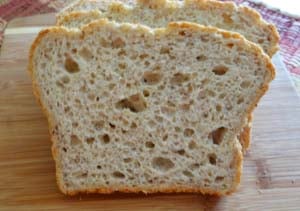
- Slice with an electric slicer, electric knife or serrated knife. (See the photo below when baked in a 9 x 4 x 4-inch pan.)
See more Gluten Free Bread Recipes.
Carla, Great bread posts. Would you please list gram or ounce weights alongside the dry measures in your recipes? I gram weigh everything for improved and predictable results. Thanks.
Hello! Is there a substitute for ACV that you know of? Thank you!
With the oat flour bread do you have to use the tapioca flour and potato starch or can you use all oat flour. Thanks Carla this will make it so much easier for my wife to enjoy bread that is GF with a texture more like what she is used to. She doesn’t have celiac but Fibromialga and gluten flares it up in her joints and achey muscles.
Timothy,
All of the ingredients listed are required. Using only oat flour will produce a bread that is extremely heavy. In addition, be sure to use an oat flour that is labeled gluten free as regular oat flour can contain as much as 10% wheat.
I hope she enjoys it.
Carla
Facebook Comment – Feb. 24, 2015,
“Made it…was really a nice loaf of bread”
~O.A.
Comment from the Gluten Free Cake Flour Blend recipe – Jan. 26, 2015,
“I have been making your oat bread regularly for the last month (it is the best GF bread we’ve ever eaten!)…”
http://glutenfreerecipebox.com/gluten-free-cake-flour-blend/
~Shiri
Made this oat bread came out great . Tried two more times but used sugar instead of honey and both times dough clumped up into ball like puty . I could barely get dough off beater. I measured by weight and know I measured properly. Any idea what happened
John,
If you added the sugar to the water, it shouldn’t have clumped. Honey works best anyways as it makes the dough softer.
Carla
I made this yesterday and it is delicious. All my family likes it. I have an oven that I’m still getting used to that has a fan, turbo type I guess, and things always get done in half the time. But then sometimes I have a tendency to under-bake things. Anyway I had it set at 350 degrees, baked it for 25 minutes then put foil over the top and baked another 10 minutes. It was in a glass dish with baking paper. It was the perfect doneness. Yummy and thanks for the great recipe!
Hi…made this bread today. Used a scale and did it to the recipe exactly. Is there a typo of 37 minutes for baking time? Should it read bake 37 minutes then tent for another 20-25 minutes to finish baking? Mine caved in.
Have you included your update into the recipe or should I have done it?
Thanks for your help :)
Hi Rocky,
This is an old recipe, therefore the update. I no longer update the recipe itself, as some of readers do not appreciate the changes to what they have already made successfully and enjoy. When using the changes in the update, you will need to add 10 – 15 minutes of bake time. The original recipe did cave in a bit. Any time a bread begins to even appear to cave in, immediately place it in back in the pan and bake it longer.
I hope this helps.
Carla
Facebook Comment – December 20, 2013,
“This is a great recipe and has replaced my starchy french loaf. It stays fresh for about three days. I also use the dough to make bread rolls. Once prepared, I freeze them and take the ones out I need for that day. Freshly baked rolls at your fingertips. Yum!”
~N.D.
Hi. I’m wondering if you have tried a variation of this recipe without the egg whites. Both my partner and I have sensitivity to eggs, and she is also gluten and dairy intolerant–quite a challenge for baking! We’ve found one bread recipe that does work for us, but I’m interested in something with gluten free oats in it.
So sad, not sure what I did wrong. The first time I made this bread, it was perfect. Tried the bread machine version and it didn’t rise. Then made the oven version again and it shrank and didn’t seem to bake evenly. ( I cooked a little longer this time.) can’t decide if ingredients were not warm enough or maybe mixed the eggs too much.
Hi Jana,
Sorry you had a couple of failures. It happens to us all, including how we measure the ingredients: if you scoop or if you use a spoon to add to the measuring cup. In addition, all dry ingredients should be measured with individual dry measuring cups, not a full 8 oz. cup. Though it is proper to use a spoon to add your ingredients to the dry measuring cup, because most of my readers do not know this, I scoop my ingredients. Weighing is more accurate. In the near future I will have a chart with weights on gluten free flours so that those who have a kitchen scale will be able to turn out more accurate recipes.
In regards to mixing the eggs, I assume you’re referring to the oven version. See this video: http://glutenfreerecipebox.com/gluten-free-bread-recipe-oat-sorghum/ . It shows what the eggs should look like.
Room temperature ingredients are definitely important, especially the eggs.
I hope this helps.
Carla
Thank you for getting back to me. I will try it again and weight the dry ingredients and make sure the eggs are room temp.
Hi on the bread instead of using all the different flours could I use gluten free our mix that already has everthjng in it if so how much would you recommend I use for a loaf of bread.thanks
Hi Joann,
Because I haven’t tried it myself, and are not familiar with the mix you will be using I cannot say how it will turn out. Just make sure you are using a flour that already contains xanthan and/or guar gum. They may use less or more gum than is called for in the recipe, which may result in a different texture, though it should be close. The key in this recipe is also the ratio of starch to flour.
Good luck!
Carla
I make this bread twice a week. I just love it. My friend has Celiac and is really struggling as he is a big bread eater. I make one loaf for him and one for me. He is head over heals in love with this bread as well. I never have a problem other than a small amount of shrinkage. I think baking longer at a lower temp may do the trick. If at 300 how long do you think it should bake? I am thinking around one hour. I always panic about bake time. Is it done in the middle? is it burned ont the bottom? Let me know what you think.
Forgot to ask is there any way to get the nutritional value per serving on this bread?
You will find nutritional value for the dairy-free version via the link in the top paragraphs. However, it is very time consuming, and my schedule doesn’t allow for it on most recipes. I did on that recipe so other would get an idea of the nutritional values for gluten free bread. Check out my article on how I figured it out: http://glutenfreerecipebox.com/gluten-free-recipe-calculator-nutrition .
Carla
Thanks, Pat! Shrinkage isn’t a problem when you add more flour. What I really need to do is to update most of bread recipes. If you bake it longer, less shrinkage occurs. A lower temp just may do the trick, as well, though more flour is needed. I baked a bread on a really low temperature once and it turned out gummy, though I had added a container of water in the oven to create a crunchy crust. It’s all an experiment. If I ever give it a try, I’ll update you.
Continue enjoying!
Carla
What would be a good sub. for the powdered milk so I can make the bread gluten and dairy free?
Hi Carey, I have a similar recipe without the dry milk, though it doesn’t rise as high: http://glutenfreerecipebox.com/gluten-free-oat-flaxseed-sandwich-bread I hope this helps. And be sure to check the improvement video at http://glutenfreerecipebox.com/video-hd-soft-gluten-free-oat-bread .
Enjoy!
Carla
Hi Carla,
I’m so pleased that you’ve added weights to the flour you used in this recipe, but shouldn’t the weights be in ‘oz’ instead of ‘g’ (4g of oat flour is really little flour). BTW do you have the weight for 1 cup of white rice flour? I’m thinking of mixing up a batch of your cake flour mix. Thanks.
I actually noticed the error myself, and forgot to change it. Thanks so much, Richard! I’ll weigh a cup of rice flour for you when I get a chance. Things are crazy at my house right now. Expecting my 98 year old father for a 2 1/2 week visit today. In addition, my husband’s place of work burned to the ground yesterday. Life happens! So, please be patient with me.
Thanks, and happy holidays to you and yours,
Carla
I would suggest that it did not bake long enough if it fell considerably. I always bake my gluten free breads at a lower temperature 300-350, and for two hours!! This gets out the moisture and helps the bread stay lofted! You need a good basis of starch to flour. I make a vegan bread and i use a three part mix, one part starch to two parts flour.
Beth,
Thanks for the advice to Harriett! This has been my recent experience, as well. Harriett and I were talking via Twitter, and baking longer is what I suggested, too. In gluten-free bread baking, it is usually the answer.
Carla
The bread had risen to the top of the pan at 30 minutes. I took my eye off for 5 minutes and it had overflowed all over the bottom of the stove. I used less than called for starches and added the 1/4 c sweet rice flour. I also added 1/4 tsp nutmeg to enhance the flavor.
Why is this overflowing and not staying together? I took it out to clean the stove preheated to 375. Now it’s about level with the pan at the proper temp. We’ll see what happens. Never a dull moment when I bake!
Thanks for the update, Harriet. It appears you followed my suggestion. How much starch did you remove? When substituting bean flour for rice flour you’ll need to expect a different result, but I highly doubt that the overflow was due to the substitution. If you are using a 9×5″ pan, you should stop the rising when it reaches 1/2″ above the pan, measuring from the center of the bread. While the oven preheats to 375 degrees it will continue to rise slightly. As soon as the oven is preheated place it in the oven, otherwise it may over rise, resulting in too airy of a dough, which may result in it falling or caved in sides or bottom. You see when that happens hot air gets trapped in the air pockets and then upon cooling the air releases and the dough caves in.
Good luck with your fixed dough. Keep up the good work!
As a side note, it so much easier to communicate, here, in more than 140 characters, versus Twitter.
Carla
You are correct! I posted a photo on twitter. It has continued to sink. I did reduce starches both by “a bit” which I interpreted as a little. Without specific amounts to reduce I did the best I could. I did not rise again in the oven and was done at about 30 minutes. May even be over baked. We’ll see when it cools off what it tastes like and if its salvageable. It’s always a walk on the wild side when baking GF! Thanks for your patience with me. I don’t know how you do this!
Harriet, hang in there! It’s crazy when substituting items. My only advice is to use recipes that have the ingredients you have on hand, or to purchase ones specified in the recipe.
Good luck on your next loaf!
Carla
No ideas why it sank? You should have seen the globs if dough all over the bottom of the oven!
I had all the ingredients. I don’t like bean flours and the aftertaste.
Oh well!
Well I just went to slice the bread. All cooled down. Wet on the counter top under the rack. It sunk more and was extremely moist and hard to slice. Good news is that it tastes good with the added nutmeg. Would like to do it again once you help me figure out what I did wrong. The nutmeg is great and the bread is better without the sorghum. Maybe too much oil?
Sorry to hear about your mess in the oven. I feel the same way about bean flours, however, fava bean flour is much lighter and you cannot taste the bean flour in this recipe at all. You have to try it!
Carla
Two of my comments are missing. I responded by saying I have all the ingredients but don’t like bean flours because of aftertaste.
The bread left moisture under the rack and when it was cooled it had a spongy consistency. Any idea what would cause that? It tasted good but it really sank and I don’t know what I did wrong.
Any ideas? Too much oil? What would make it spongy and sink?
Thanks
Harriet
Hi Harriet,
All comment are moderated, meaning I need to approve them prior to them being published. When I have time during the day I check them and publish them, and answer any questions.
Carla
Harriet,
I just noticed that the recipe you’re commenting is different than the recipe you’re referring to, as there is no bean flour in this one.
Carla
Now that we have sorted out mix up in recipes. I would normally substitute chia seeds for flaxseed meal. Another one, but with added flavor is almond meal/flour. If you don’t have either you may try adding 1 whole egg, but expect a bit of different results. I haven’t tried this myself.
Yes I confused the 2 recipes, but this is the one I used and I subbed sweet rice flour for flax and reduced starches. I ate the bread today and its so spongy and odd. Flax or bean don’t like me. I’m thinking sorghum doesn’t either. How can I make this recipe again with good results? I add a whole egg in lieu of flax but what abt reducing the starches? I just want a good sandwich bread w/ingredients I can have. That’s not too much to ask??? Thx Carla. You are a peach.
I understand completely. See my suggestions above your last comment.
Carla
This sounds delish! I want to make this asap!